Free tunnel alternatives to ngrok: what the free tiers actually give you today
The old complaint about rotating free URLs is out of date. Here is what ngrok's free plan prints today, checked on their own page, and where a built-in tunnel differs.
Most write-ups about ngrok alternatives repeat a complaint that is no longer true: that a free tunnel gets a new address every restart. We checked ngrok’s pricing page on 11 September 2026, and the free plan now includes an assigned development domain that is, in their words, “specific to your account”.
So here is the honest version, with the figures their page prints today.
What ngrok’s free plan prints today
Checked on 11 September 2026 at ngrok.com/pricing:
- $5 of one-time included usage, with no additional usage beyond the credit
- Up to 3 online endpoints
- Up to 1 GB data transfer
- Up to 20k HTTP/S requests
- An interstitial page on HTTP/S endpoints, which the Hobbyist and Pay-as-you-go columns print as “No interstitial page”
- An assigned dev domain for public endpoints, one team member, three concurrent agents
Their FAQ adds that the credit lasts a year after it is granted, can only be spent on the free plan, and cannot be used on data transfer out. Bring-your-own custom domains are on Pay-as-you-go and up. Figures change, so check the page rather than this post.
The interstitial is the line to notice if you are sending a link to a client. A page that says “you are about to visit a tunnel” between them and the work is not a good look in a review thread, and it is a free-tier-only imposition rather than a technical limit.
What ngrok does better
Protocol breadth. It tunnels more than HTTP: TCP, TLS and others. If you need to expose a database port or a non-web service, that flexibility is hard to match.
Standalone and universal. One tool that works with anything on any operating system, independent of how you run your app. Point it at a port and go.
Mature features. Request inspection, replay, and a feature set built over years.
If you tunnel arbitrary protocols, or you want one tool decoupled from your development environment, it is a solid general-purpose choice. Use it.
What a built-in tunnel does differently
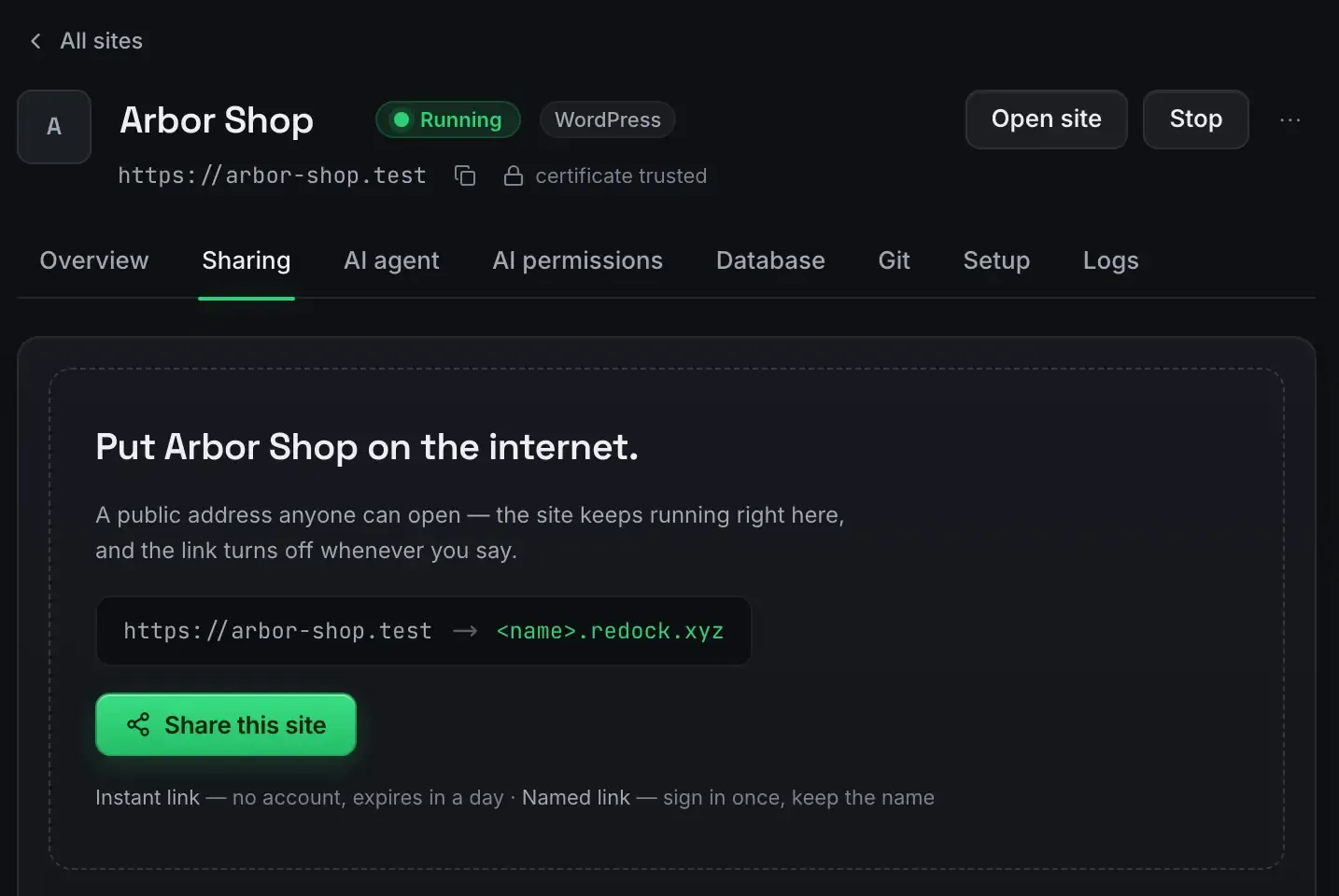
ReDock shares the sites it already runs, over Cloudflare tunnels, in two shapes.
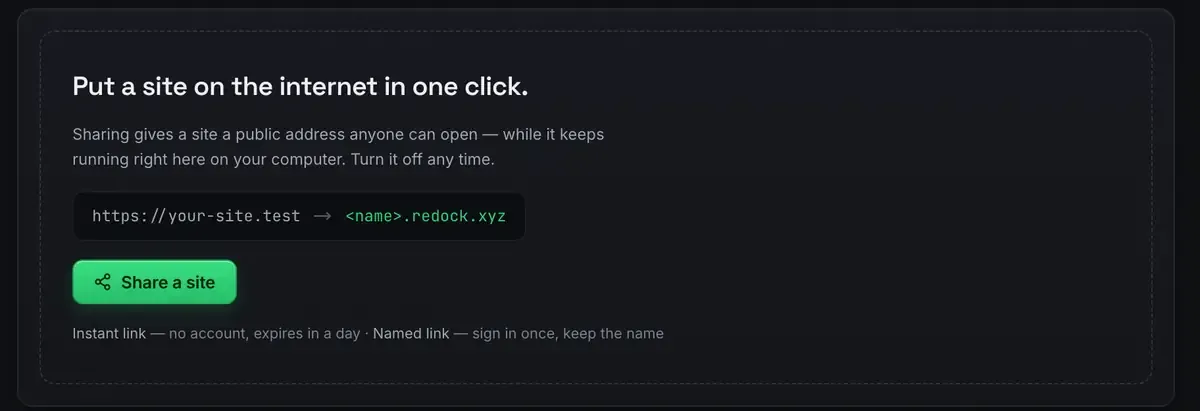
Quick links are unlimited and unlisted, need no account, and expire in a day.
Named links keep their name for as long as you use them. Three of those, on every plan.
Neither carries an interstitial, neither has a monthly request cap of the kind above, and there is no separate binary to run alongside your site: you are sharing the site the app is already hosting.
The network they run on comes with your account and needs no setup of its own.

The honest scope: these tunnel the web sites ReDock hosts. They are not a general-purpose tunnel for arbitrary services. If you need to expose a raw port, that is ngrok’s territory and it is genuinely better at it.
Choosing
Need to tunnel arbitrary protocols? ngrok.
Want one standalone tool independent of your development setup? ngrok.
Sharing local web sites, and would rather nobody sees an interstitial before your work? A built-in tunnel.
Just need a quick one-off share? Either.
Beyond tunnels
Sharing is one step; sometimes you want the site permanent instead. A one-click Cloudflare deploy takes a local site to a hosted address, which deploy a website for free walks through. For where free tiers fit in the larger picture, hosted free tiers versus owning your stack, and for the tool landscape, MAMP alternatives.
FAQ
Do free ngrok URLs still rotate?
Not according to their pricing page as of 11 September 2026: the free plan includes an assigned development domain specific to your account. The rotating-URL complaint you will see in older posts is out of date, and we would rather correct it than repeat it.
So what is the free-tier catch on ngrok today?
Mostly the interstitial page on HTTP/S endpoints, which only the free plan carries, plus a one-time $5 credit, 3 online endpoints, 1 GB of transfer and 20k requests. Their page has the current numbers.
Can ReDock tunnel non-web services?
No. It shares the web sites it hosts. For arbitrary TCP, TLS or SSH tunnelling, ngrok is the right tool.
Is ReDock’s sharing actually free?
Yes. Unlimited quick links plus three named subdomains, the same on every plan including Free, over your own Cloudflare account.
Want a link with no interstitial in front of your work? Download ReDock for macOS or Windows.